

Sparta mercury filling removal, the SMART way
Old silver fillings removed under the IAOMT's SMART protocol and replaced with biocompatible white fillings at our holistic dental office in Sparta, NJ.
Written by the Dr. Ewa Zoltek DMD team. Medically reviewed by Dr. Ewa Zoltek, DMD, DICOI. Last reviewed: October 2026.
Maybe a cracked silver filling is what brought you here. Or maybe it’s a bigger question: what’s in your mouth, and how does it fit with the rest of your health?
If you’re looking into Sparta mercury filling removal, how the filling comes out matters as much as whether it does. At Dr. Ewa Zoltek DMD, we remove amalgam with a step-by-step safety protocol and walk you through it before you decide.
What SMART amalgam removal means
SMART stands for Safe Mercury Amalgam Removal Technique, a protocol developed by the IAOMT (International Academy of Oral Medicine and Toxicology) for taking out silver fillings while limiting the mercury vapor and particles the patient and the dental team breathe in. At our Sparta office, every amalgam filling comes out under that protocol.
According to the FDA, amalgam is about 50% mercury by weight. A sound filling left alone gives off small amounts of vapor. Drilling one out without precautions sends far more vapor into the air in minutes than the filling gives off sitting in place. That’s the exposure the SMART protocol is built to limit.

Mercury-free vs. mercury-safe: Understanding the difference
“Mercury-free” means we don’t place amalgam. Every filling we do is tooth-colored and metal-free.
Being mercury-safe means removing existing amalgam fillings under a protocol that protects you, our team, and the water supply. Dr. Ewa Zoltek follows the SMART protocol for every one. If you’re looking for mercury-safe care in Sussex County or Morris County, we’ll walk you through each step of the protocol before you decide.
The SMART protocol, step by step
The SMART protocol, as developed by the IAOMT, lays out safeguards for the room, the team, the patient and the waste.
Before the filling comes out
- An amalgam separator: a filter on the suction line so mercury doesn’t drain into the wastewater.
- High-volume air filtration: a dedicated unit running in the treatment room for the whole procedure.
- An adsorbent rinse: a rinse with activated charcoal or chlorella just before removal begins.
- Barriers for you: protective covers, a full-body drape and nitrile gloves, plus external air or oxygen through a nasal mask.
- Barriers for the team: a mercury-rated mask and nitrile gloves for every person in the room.
During removal
- A nitrile dental dam: isolates the tooth, with a saliva ejector under the dam and an at-source aerosol vacuum beside your mouth.
- High-speed suction and copious water: keeps the filling cool and pulls vapor and particles away as they form.
- Sectioning, not grinding: the filling is cut into chunks and lifted out rather than ground into dust.
After the filling is out
- A final rinse and regulated disposal: you rinse again, and the amalgam leaves the building as regulated waste, not in the trash.
Meet the dentist behind the protocol
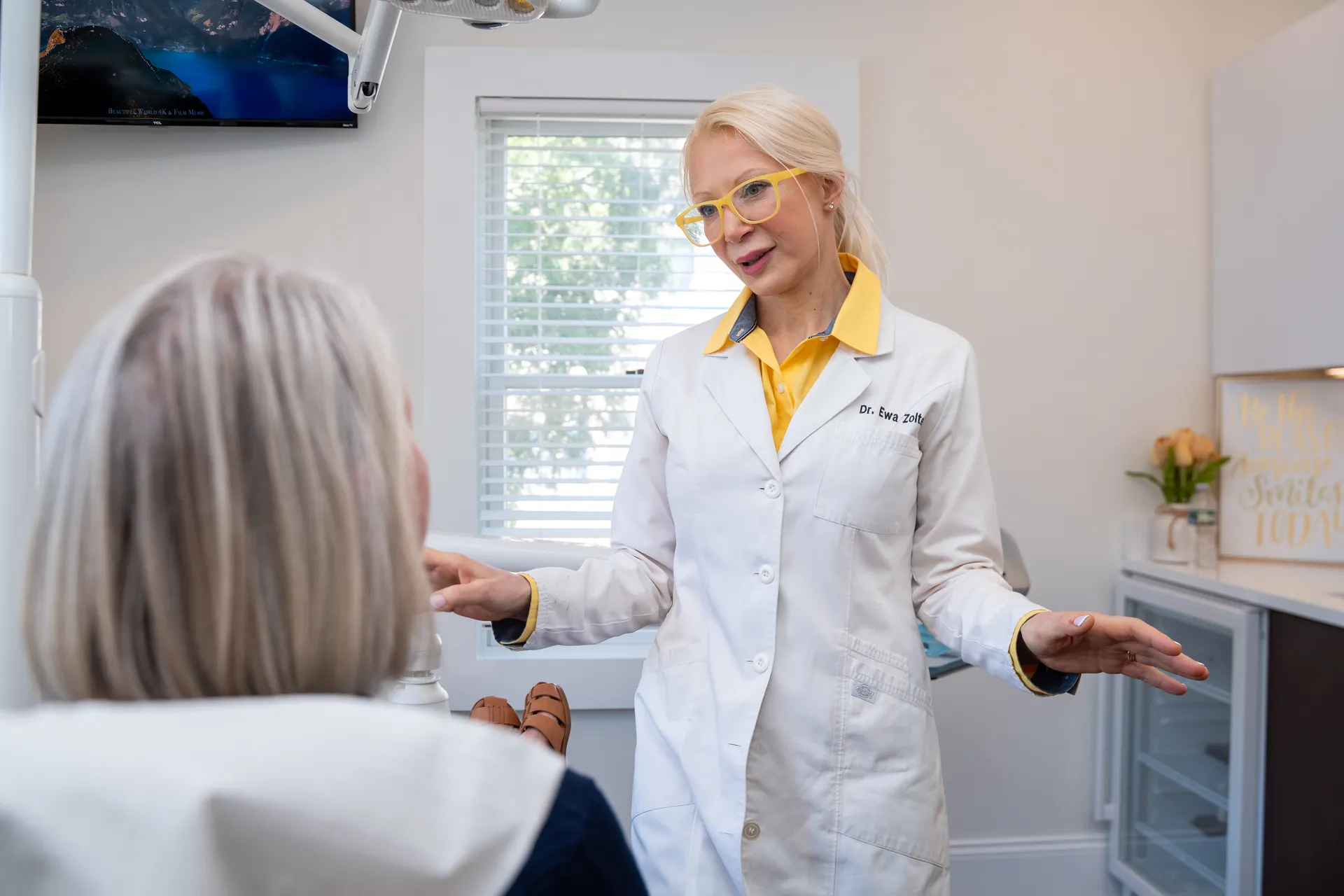
Dr. Ewa Zoltek, DMD, DICOI, has cared for patients in Sussex County for more than 18 years. After dental school, she pursued post-doctoral training in biological dentistry, oral-systemic health and integrative approaches to healing. She’s a member of the IAOMT, the academy that publishes the SMART protocol, and of the American Academy for Oral Systemic Health.
Is it time to take out your silver fillings?
Not every amalgam filling needs to come out. Replacement is a conversation, and we won’t push it. Some patients choose to leave a sound filling alone, and that’s a reasonable choice.
Removal tends to make sense when:
The filling is failing
worn edges, cracks, leaking margins or corrosion, seen on an exam or a 3D scan.
You’ve talked it over with your physician
a material concern you’ve already discussed with your doctor, which we’ll work alongside.
You want to move away from metal
a preference for metal-free restorations, handled carefully.
Whatever the reason, your plan also looks at why each tooth needed a filling in the first place, so you’re less likely to need another one.
One exception: following IAOMT guidance, we don’t remove amalgam during pregnancy or breastfeeding. If that’s your situation, we’ll help you plan the work for later.
What goes back in, chosen for your body as well as the tooth
Taking the metal out only helps if what replaces it suits your body. We use biological, biocompatible materials only, and a 3D CBCT scan and intraoral camera images show how much healthy tooth is left to work with.
BPA-free composite white fillings
For most teeth, the replacement is a biocompatible, BPA-free composite. It’s tooth-colored, metal-free and bonded to the tooth rather than packed into it.
Porcelain crowns for larger restorations
When an old filling took up most of the tooth, a new filling alone won’t hold. Those teeth get a porcelain crown made from biocompatible materials, so the tooth stays protected.
An office set up for this work
Air, water and instruments all matter when mercury is involved. Our Sparta office runs ozone clean-air purification, in-house water filtration and biological monitoring to verify instrument sterilization.
Safe removal as part of whole-body care
The mouth is the gateway to your health, and removing an old filling is one part of a larger plan. When appropriate, nutritional guidance may be part of your treatment plan.
Your body works as one system, so what happens in your mouth affects the rest of your health. Around your removal, your plan may include:
- Nutrition: Dr. Zoltek looks at how diet affects your teeth, gums and oral microbiome, and may add nutritional guidance to your plan.
- Healing support: when appropriate, therapies such as ozone or Photobiomodulation (ATP38) may be used to support comfortable healing.
Costs & coverage for amalgam removal in Sparta
After your first visit, we’ll review a plan for your whole mouth with you: which fillings to replace, in what order, over how many visits, and the cost of each step.
We’re out-of-network with all dental insurance. We’ll file your claim as a courtesy so your plan can reimburse you at its out-of-network rate, and our in-house membership plan and flexible financing can spread the cost out.
Hear from our patients
Zachary
"Over the years that I've been coming here, I now consider them my family. It's not just the dentist. I'm going to see my friends. I'm going to see my family."
Leonard
"She clearly cares about her patients, she is invested in doing the best care for the patients. I recommend her wholeheartedly."
Melanie
"I really love Dr. Z’s approach to dentistry. She really cares about you starting with the mouth, and then your whole body health."
Frequently asked questions
How much does it cost to have a mercury filling removed?
The cost depends on how many fillings you have and how many teeth need a crown afterward, so we don’t publish prices. After your first exam at our Sparta office, you’ll get a written plan with the cost of each step, and our membership plan and financing can help with it.
Is it safer to leave my silver fillings in or take them out?
It depends on the filling and on you. A sound, intact amalgam releases small amounts of vapor, and drilling it out without precautions releases more. That’s why we only remove fillings under the SMART protocol, and why we’ll tell you plainly if yours are fine to leave alone for now.
How long does Sparta mercury filling removal take?
One amalgam filling usually takes a single appointment. If a tooth needs a porcelain crown, plan on a second appointment a few weeks later to seat the lab-made crown.
Do you remove amalgam fillings during pregnancy?
No. The IAOMT doesn’t recommend removing amalgam during pregnancy or breastfeeding, and we follow that guidance for every patient. If you’re expecting or nursing and a filling is bothering you, come in anyway. We can examine the tooth, keep an eye on it, and plan the removal for after you’re done nursing.
What's the difference between SMART and standard filling removal?
Standard removal uses water spray and suction. SMART adds an adsorbent rinse, a dental dam, nasal oxygen, a mercury-rated mask for the team, an at-source vacuum, sectioning instead of grinding, and an amalgam separator for the wastewater.

When holistic care
made all the difference

Ready to take the next step toward better health?
Ready to take the next step toward better health?
Find Us
41 Main Street
Sparta, NJ 07871
Our Sparta dentist sees patients from the entire greater Sussex County area!
Visit Us
Monday: 11:00am-5:00pm
Tuesday: 10:00am-6:00pm
Wednesday: 11:00am-5:00pm
Thursday: 10:00am-6:00pm
Friday: 10:00am-3:00pm
Saturday & Sunday appointments coming soon